
Gangs of Manchester: The story of James Cowan and William Willan
In the late 19th century, Manchester was a city of booming industry, but also of extreme poverty and crime. The rapid expansion of mills and factories brought a surge in population, and with it, overcrowded slums where violence became a part of daily life.
Gangs roamed the streets, carving out territories and engaging in brutal turf wars. Among the most notorious were the Bengal Tigers of Bengal Street in Ancoats, the Meadow Lads from Angel Meadow, and the Grey Mare Boys from Grey Mare Lane in Bradford, Manchester.
These young gang members were known as scuttlers, instantly recognizable by the distinctive neckerchiefs they wore—each gang adopting its own color and style. One of the most feared and powerful gangs of the era, the Bengal Tigers, operated in Ancoats in the mid-1880s – and among their number was our maternal great grandfather, James Cowan.
James Cowan: A Bengal Tiger
James Cowan was born in 1873 into a large working-class family. He was one of seven children, though two of his siblings did not survive infancy—a stark reminder of Manchester’s high mortality rates at the time.
By 1891, James and his family were living on Primrose Street, Ancoats, just one street away from Bengal Street, the heart of the Bengal Tigers’ territory. Like many young men in the area, he worked in the textile industry as a cotton dyer, a physically demanding and often dangerous occupation.
The Other Side: William Willan and the Bradford Street Scuttlers
At the same time, William Willan was growing up in similar surroundings. Born in 1875, he was the eldest son of Hannah Jane Spencer (our 2x great-aunt) and George Willan.
William became a member of the Bradford Street Scuttlers, another fiercely territorial gang.
By 1892, tensions between rival gangs were reaching boiling point. One of the most bitter rivalries was between the Bradford Street gang and the Lime Street gang. The ongoing hostilities led to a series of violent encounters, culminating in a tragic event on Saturday, April 17, 1892.
The Fatal Encounter – 17 April 1892
On Saturday, 17 April 1892, these tensions culminated in tragedy.
William Willan, aged just 16, bore a grudge against Peter Kennedy, also 16, a member of the Lime Street gang. In a city where crossing into enemy territory could provoke violence, Kennedy’s daily journey home took him through dangerous ground.
Aware of the risks, Peter arranged to walk home with four friends that afternoon. They were joined by 19 year old James Cowan, (my great-grandfather). His presence as a Bengal Tiger was intended to offer protection as they passed through the rival gang’s stronghold.
However, as the group reached the corner of Mill Street and Great Ancoats Street, they were confronted by William Willan. In the ensuing altercation, William fatally stabbed Peter Kennedy.
Kennedy died from his wounds two weeks later
Justice and Betrayal
William Willan was quickly arrested, and following Kennedy’s death, the charge against him was elevated to murder.
What made this case particularly unusual was that members of Willan’s own gang testified against him. While violence between gangs was common, there was an unspoken rule—maim, don’t kill. Willan had broken that code.
Among the key witnesses for the prosecution was James Cowan (my great-grandfather). His testimony would play a role in securing Willan’s conviction.
Found guilty, William Willan was sentenced to death. He was sent to Strangeways Prison, where he awaited execution in the condemned cell.
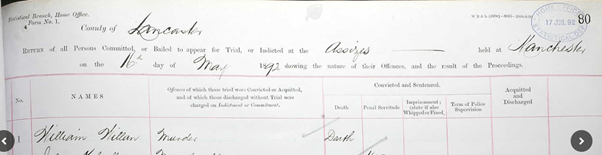

North Devon Gazette 24 May 1892
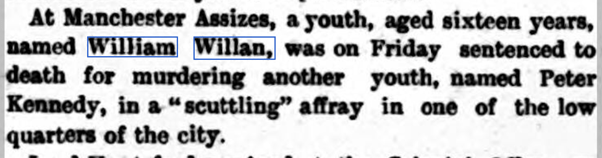
Oxfordshire Weekly News 25 May 1892

Manchester Times 3 June 1892
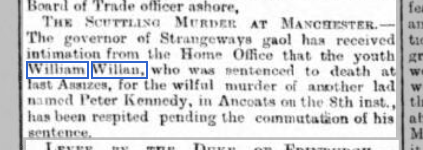
Aberdeen Press and Journal 1 June 1892
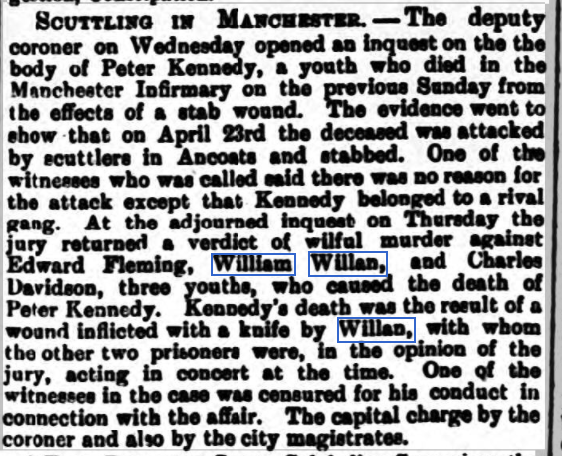
Penrith Observer 17 May 1892
A Plea for Mercy: The Fight to Save William Willan
Public interest in the case was intense, particularly in Ancoats. At the centre of the efforts to save William was his mother, Hannah Willan, who refused to accept her son’s fate.
On Monday, May 23, 1892, a petition for clemency was prepared, emphasising William’s youth and raising doubts about whether he had delivered the fatal blow. Thousands of signatures were gathered – a remarkable show of support at a time when capital punishment was rarely challenged.
An Appeal to Jerome Caminada
In a remarkable turn of events, the case drew in Jerome Caminada, one of Manchester’s most famous detectives.
Though not been involved in the original investigation, he was asked to visit Willan in prison. The detective later wrote in his memoirs that the scene haunted him for the rest of his life:
“The poor lad put his arms through the bars and implored me to save him, as tears ran down his face.”
Outside the prison, he encountered William’s mother, Hannah, who also pleaded for help. Deeply moved, Caminada joined the campaign for clemency.
A Last-Minute Reprieve
On May 30, 1892, just days before the scheduled execution, William Willan’s sentence was commuted to life imprisonment – a rare outcome at the time.
William served eight years in prison before being released in 1900. Returning to civilian life, he resumed work as a cooper and settled in Harpurhey.
An Unexpected Connection
In an extraordinary twist, in 1905, William married Florence Caminada, the niece of Jerome Caminada – the very man who had helped save his life.
The following year, their son, William Louis Willan, was born—a new generation emerging from a story of crime, redemption, and unlikely alliances between a gang member and a detective.

Philips Park Cemetery – Willan Plot
http://news.bbc.co.uk/local/manchester/hi/people_and_places/history/newsid_8233000/8233388.stm
The Gangs of Manchester : Andrew Davies
 Family