
Mary Spencer was my grandfather’s sister, yet for many years she remained a mystery. It was only well into my family history research that I first uncovered her existence – and even then, her story proved elusive, requiring patience and persistence to piece together.
My initial searches through birth records were challenging. “Mary Spencer” is a common name, and without a confirmed birth year, progress was slow. Family history research is rarely straightforward; transcription errors, inconsistent dates, and variations in spelling are common obstacles. In my own searches, I encountered the surname recorded as Spencer, Spenser, Spensar, and even Spenir.
Census records, taken every ten years since 1841, are invaluable tools, and with records up to 1921 now available online, I hoped Mary might appear there. I focused particularly on finding her mother, Bertha, who less common name might help narrow the search.
Then, in 2017, came the breakthrough. Bertha had remarried and was now listed as Bertha Hyde – and Mary appered in the household, her name transcribed as “Mary Spenar.”
Mary Ann – her story
Mary was born on 21 February 1902 at 18 Thursday Street, Manchester—most likely at home, as was typical at the time. Mary was the third child born to Bertha and Henry Spencer, though older siblings, William and Sarah Ellen, had died before her birth.
Her mother, Bertha Spencer (née Boot), registered her birth, marking the document with an “X” instead of a signature, a common indication of illiteracy.

Mary’s father, Henry Spencer, worked as a greengrocer but suffered from poor health. In the 1901 the census, taken on 31 March, he was recorded as an inmate in the Workhouse & Workhouse Hospital at Crumpsall, suggesting he was already seriously ill. When he died in 1907, the cause was given as ‘cardiac syncope, acute pthisis’ – TB and heart problem – making it highly likely he had been in the Workhouse Infirmary.
Henry and Bertha had two further children, Alfred, born in 1904 and a sister, Bertha, born in February 1907. Tragically, the family suffered devasting losses that same year. Henry died on 29 October 1907, and just six days later, on 3 November 1907, their infant daughter Bertha – only nine months old – also died, her death attributed to cerebral haemorrhage and cardiac arrest.
They are buried together in Phillips Park Cemetery, in grave D859.
A New Family
Life would have been extremely difficult for Bertha as a widowed mother with young children and limited support. On 31 March 1908, she remarried, to James Hyde.
The 1911 census records Mary, aged nine, living at 37 Crissey Street, Failsworth, with her mother, stepfather, and younger stepbrother Joseph. She was attending school, suggesting some stability had returned to the household.
War and Loss
At the outbreak of the First World War, James Hyde enlisted in the British Army. He served in Flanders and northern France but was killed in action on 19 August 1917.
He is buried at Bard Cottage Cemetery, and Bertha was widowed for a second time.
Mary’s Final Year
Little more is known about Mary and her life; on 24 October 1918, Mary died at the age of just 16. The cause of death was recorded as morbus cordis, a general term for heart disease.
She was buried on 28 October 1918 at All Saints Church, Newton Heath.
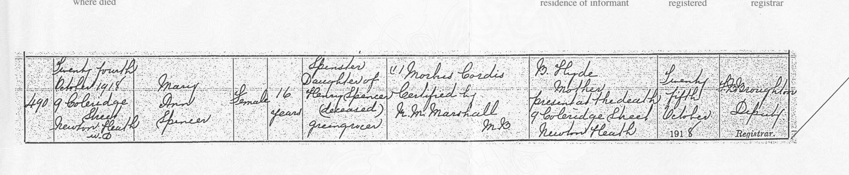
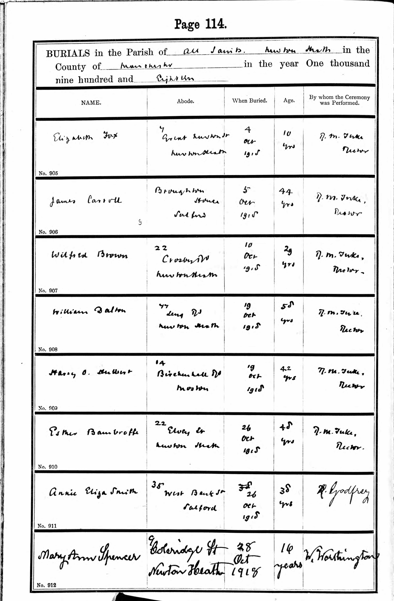
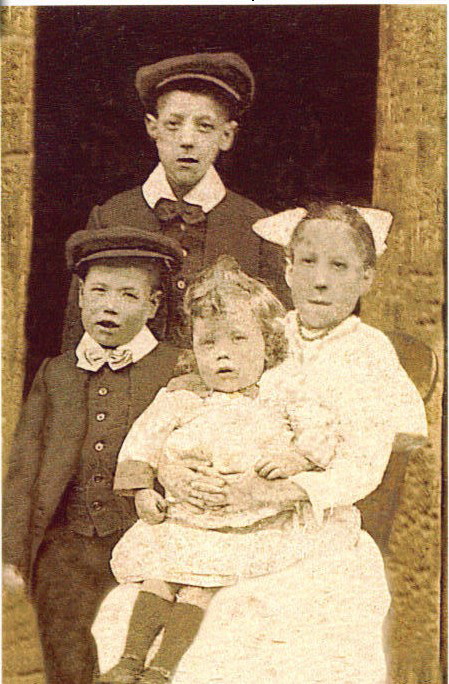
The image below shows, Alfred Spencer b1904, standing at the rear, likely with his two step siblings Joseph b1910 and James b1914 with Mary. It is likely that this picture was taken around 1915, possibly as a keepsake for James.
Though Mary’s life was brief, her story is no longer lost. Through careful research and persistence, she has been brought back into the family narrative—ensuring she is remembered as more than just a name, but as a daughter, sister, and part of a wider story shaped by hardship, resilience, and survival.
 Family