
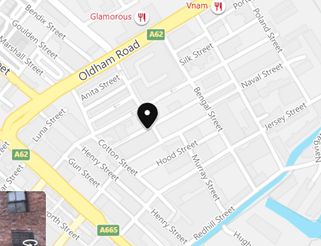
James was born on 30 October 1873. At the time, his family lived at 45 Loom Street, Manchester (just off Oldham Road on the way into Manchester centre).
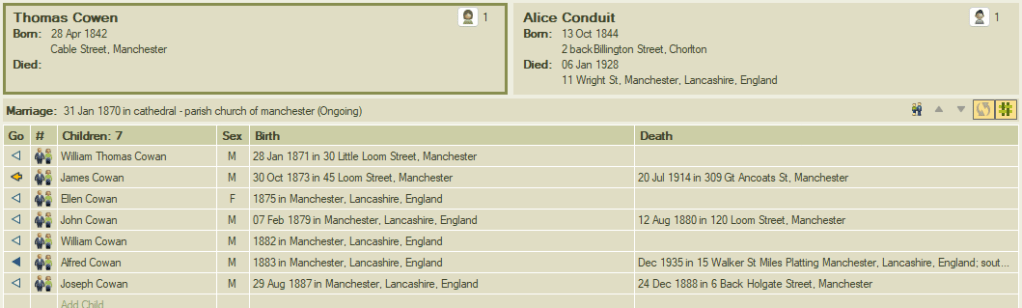
He was the second son for parents Alice and Thomas. He was one of 7 children.
It is not uncommon to find discrepancies between birth certificates and baptism records, particularly in the 19th century. Births had to be registered within 42 days, often involving a small fee. Variations in recorded dates could occur due to memory lapses, misunderstandings, or clerical errors — especially in families with limited literacy.
In James’s case, his birth certificate gives his date of birth as 30 October 1873, with the registration completed on 8 December 1873, just within the 42-day legal requirement.
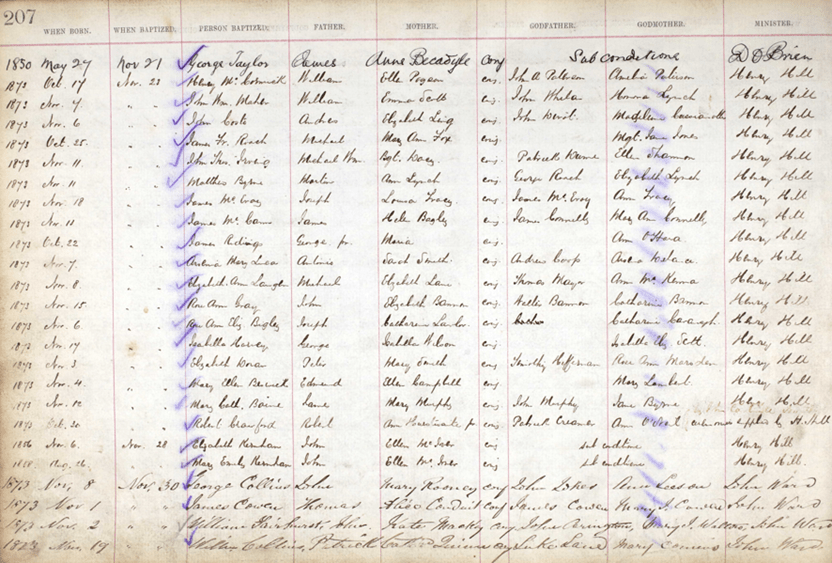
His baptism took place on 30 November 1873, the church register records his birth date as 1 November 1873.
Although the birth certificate is the official legal record, this discrepancy illustrates how easily dates could become confused at the time, and why such inconsistencies are frequently encountered in historical research.
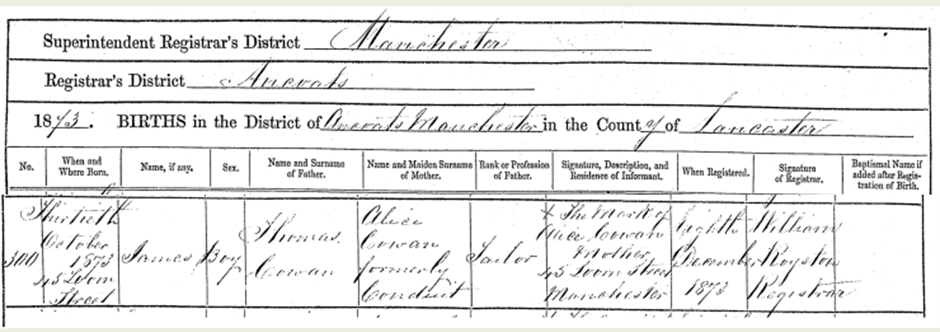
Copy of Thomas’ birth certificate and the baptism record
Tracing an ancestor’s life through census records is relatively straightforward. James should appear in the 1881, 1891, 1901, 1911 and 1921 census records, providing insight into his whereabouts and occupation over the years. Key life events – births, marriages and deaths – are confirmed through registration records and certificates.
| 1873 | 45 Loom Street | James was born on 30 October 1873. His father was Thomas Cowan, a tailor and his mother was Alice Conduit. His birth was registered on 8 December 1873. Loom Street is located off Oldham Road and can also be accessed via Great Ancoats Street; it has in recent years been redeveloped |
| 1881 | 3 Taylors Court | At 8 years old, James was living with his father, Thomas (30), a tailor, and his mother, Alice (30). He had an older brother, Thomas (11),and a younger sister, Ellen (6). All three children are registered as “scholars,” suggesting they were attending school at the time. |
| 1891 | 66 Primrose Street | By the age of 17, James was working as a dyer, most likely in a cotton mill. He was still living with his mother Alice, his father was not recorded with them. Alice is recorded as married, not widowed, indicating that Thomas was away from the home on the evening the census was taken. |
| 1892 | The Gangs of Manchester | Gang culture was rampant in Manchester, and James was a member of one of the most notorious gangs – the Bengal Tigers. In 1892, the paths of both sides of our family (Bletcher/Cowen & Spencer/Willan) briefly crossed due to a gang related incident. (see full story on pages ‘when worlds collide) |
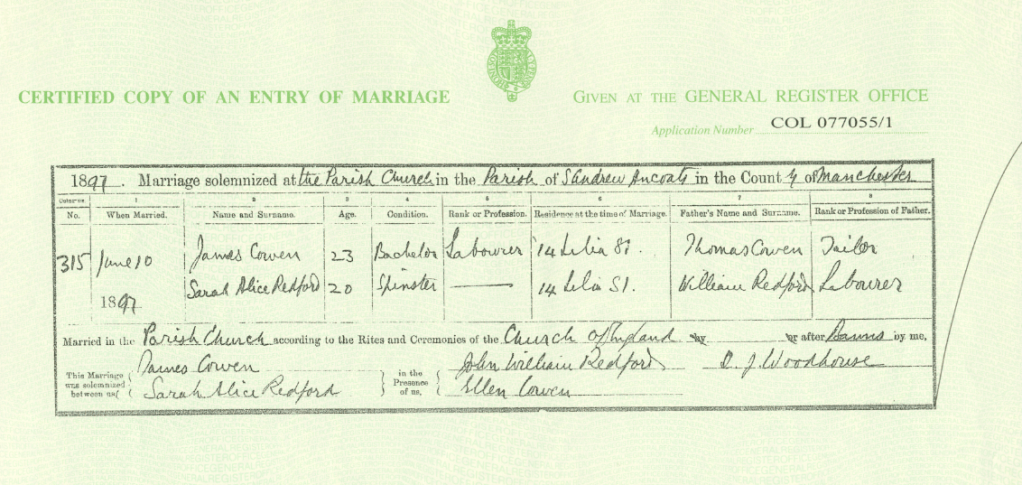
| 10 June 1897 | St Andrews Church, Ancoats | James married Sarah Alice Redford |
| 2 June 1899 | Sarah Elizabeth , their daughter, was born. The birth was registered on 24 July 1899, the family lived at 12 Jones Street. | |
| 1901 | 1 Peter Street | James is 27 and living with wife Sarah, 24 and their daughter Sarah age 2. James has recorded his occupation as ‘scavenger (corporation) |
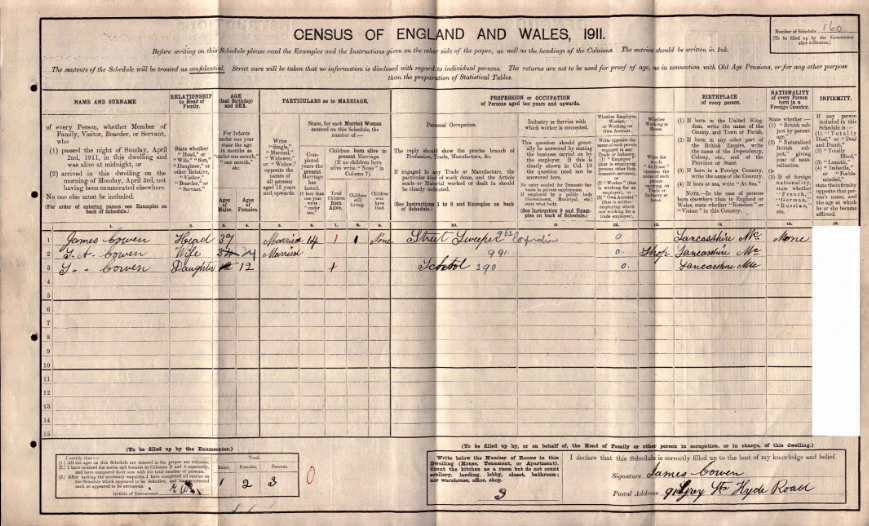
| 1911 | 91 Grey Street, Hyde Rd | James is living with his wife Sarah and their young daughter, also Sarah. James records his occupation as street sweeper (corporation). Grey Street still exists, although it is now an industrial area with low level units; there is no trace of the houses which would once have filled the street. |
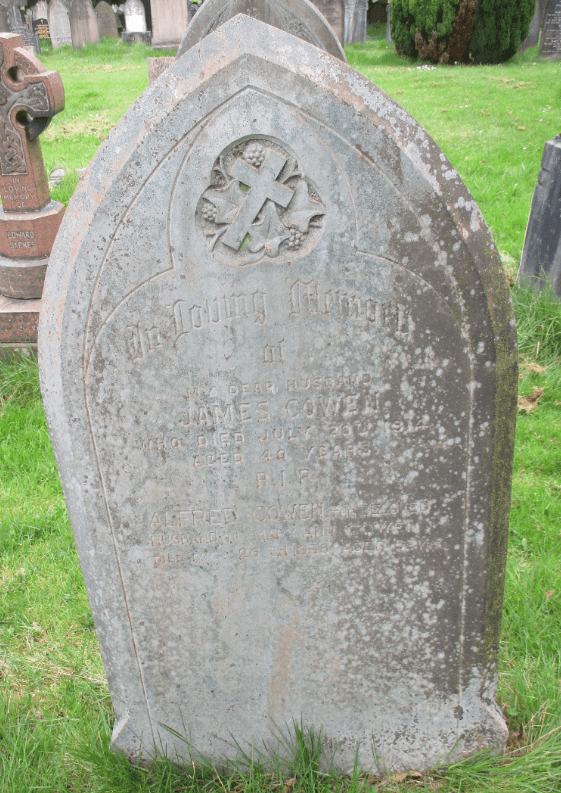
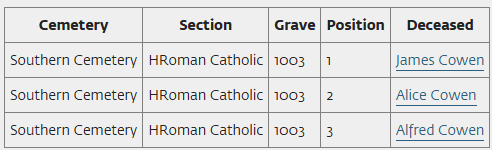
| 20 July 1914 | 309 Gt Ancoats Street | James passed away at the young age of 40. His cause of death recorded as peripheral neuritis – a condition where nerve damage disrupts communication between the brain, spinal cord and the rest of the body. This can cause pain, loss of sensations, muscle weakness, abnormal blood pressure, digestive issues, and other complications. Once possible cause is exposure to toxic substances – James worked as a dyer’s labourer, which may have contributed to his condition. At the time of this death, the family was living at 309 Great Ancoats Street. He was laid to rest in the Roman Catholic section of Southern Cemetery (section H, Grave 1003). This was a family plot, where he was buried with his mother and brother. |

Life was extremely hard in the late 19th and early 20th centuries, especially for working-class families in industrial cities such as Manchester. Long working hours, low wages, and overcrowded housing were common, and many homes lacked proper sanitation. Illness and disease spread easily in these conditions.
For men like James, daily work was physically demanding and often hazardous. Street cleaning in an industrial city meant constant exposure to filth, soot, and infectious waste, while work in the dyeing and bleaching industries involved continual contact with harmful chemicals. These harsh working conditions took a toll on the body.
The realities of working-class life at the time meant that many men—James among them—suffered long-term health problems as a direct result of their employment. Sadly, it was not unusual for this kind of labour to lead to chronic illness and, ultimately, an early death.
The Early Years
James was one of seven children born to his parents, Thomas and Alice. His grandfather, John, was born in Ireland in 1823 and later travelled to England. In the 1841 census, John is recorded as 20 years old and working as a tailor. However, if his birth year is accurate, he would actually have been 18 at the time. This small discrepancy is easily explained by the 1841 census practice of rounding adult ages up or down to the nearest five years—so someone aged 13, for example, might be recorded as 10.
John went on to marry twice and had a total of twelve children, meaning James grew up surrounded by a large extended family. With so many siblings, aunts, uncles and cousins living nearby, family connections would have been a significant part of daily life.
When James was born, the family were living at 45 Loom Street, Manchester. His grandfather James lived just a few doors away at 67 Loom Street, so family support and close-knit relationships would have been part of everyday life.
By 1880, the family had moved to 120 Loom Street, where they faced a heartbreaking loss. James’s younger brother John died on 12 August 1880 at just 18 months old. His cause of death was recorded as marasmus — a severe form of malnutrition caused by chronic undernourishment. Sadly, illnesses linked to poverty were all too common in overcrowded areas like Loom Street, where working-class families often struggled to make ends meet.
In 1888, the family suffered another tragic loss. Their youngest son, Joseph, died on 24 December 1888 — a heartbreaking blow, especially coming on Christmas Eve. His cause of death was recorded as bronchitis (14 days) and congestion of the lungs.
Respiratory diseases were extremely common in the crowded, polluted streets of industrial Manchester, where damp homes, coal smoke and poor ventilation made conditions especially harsh for young children. For James’s family, this was another reminder of the fragility of life during that era.
Life continued for the family, moving from one rented home to the next as their circumstances changed — something that was entirely typical for working-class families in late-19th-century Manchester. These moves were rarely about choice and more often driven by necessity: changes in employment, rising rents, overcrowding, or the simple need to find slightly better conditions whenever the opportunity arose.
Most homes in the Ancoats and New Cross districts were short-term rentals owned by local landlords or property companies. Tenancy agreements were informal, and families could be asked to leave with little notice. Just as commonly, they moved voluntarily to escape damp rooms, high rents, or worsening sanitary conditions. In densely packed areas where back-to-back houses and courts were the norm, a family’s health and finances were always precarious.
The census records capture these shifting addresses like stepping stones through time, each one reflecting a moment in their lives: a new baby, a death in the household, a change in James’s father’s work, or simply the need to find somewhere marginally more affordable or less crowded. For families like theirs, this constant movement wasn’t unusual — it was simply part of surviving in industrial Manchester.
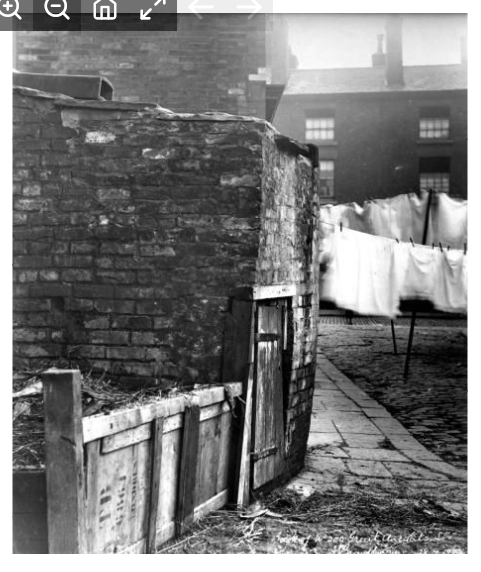
1903
Back of 200 Great Ancoats Street, likely no more than a 10-minute walk from the New Cross district where the family lived for several years. Scenes like this give a realistic sense of what everyday housing would have been like for James and his family in late-19th-century Manchester — rows of cramped back-to-back dwellings, narrow courts, shared yards, poor drainage and very little sunlight.
Working Life
In 1891, James was 17 years old and living with his mother and brothers and sisters on Primrose Street, still in the New Cross area. He was working as a cotton dyer in a local mill — a physically demanding and often hazardous job. Dyers were responsible for preparing large dye baths by boiling water and carefully mixing in the correct chemicals to achieve the required colours. Maintaining the right temperature throughout the process was crucial, and mistakes could damage the cloth or cause dangerous reactions.
Once the dye bath was ready, the cloth was immersed and agitated to ensure an even colour. This meant James would have been exposed daily to steam, intense heat and strong chemical fumes. Many of the dyes and mordants used at the time — including acids, caustic soda and heavy metal compounds — were harmful, especially without modern protective equipment.
In addition to the dyeing itself, James would have been responsible for cleaning and maintaining the machinery, which posed further risks. Mills were noisy, poorly ventilated environments, and accidents involving boiling liquids, moving machinery or chemical burns were unfortunately common.
Working as a cotton dyer required strength, stamina and attention to detail, and it inevitably took a toll on the health of those employed in the trade — something that may help explain aspects of James’s later life and wellbeing.
Death in Ancoats
Gang life in Manchester was rife in the late 1800s. Rival groups such as the Bengal Tigers, the Bradford Street Gang and the Lime Street Boys dominated the streets, each claiming their own territory. Young boys were often recruited based on where they lived, and joining a gang was seen as both protection and a rite of passage.
James was a member of the notorious Bengal Street Tigers, the gang were known for their involvement in violent street fights. However, there is no way of knowing how deeply James himself was involved in gang life.
Peter Kennedy, aged just 16, was a member of the Lime Street Boys. Each day, after finishing work, he had to make his way home through streets controlled by the Bradford Street Gang. This was a dangerous route, and tensions were always high.
William Willan, the grandson of my paternal grandparents, was a member of the Bradford Street Gang. An earlier altercation between Peter and William meant that Peter could no longer pass safely through their territory.
In April 1892, Peter arranged for four lads to accompany him on his walk home, hoping safety in numbers would protect him. On their way they met James, who agreed to join them. James’s presence should have guaranteed safe passage.
But despite this, a violent confrontation broke out. During the fight, Peter was stabbed and later died from his injuries.
William was charged with murder. At the trial, one of the key witnesses for the prosecution was James Cowan.
Married Life
In 1897, at the age of 23, James married Sarah Anne Redford, who was 20, at the Parish Church of St Andrew’s on Store Street, Manchester. It is likely that they declared the same address when giving notice of their intention to marry, as this meant the banns only needed to be read in one parish—an important saving for couples with limited means.
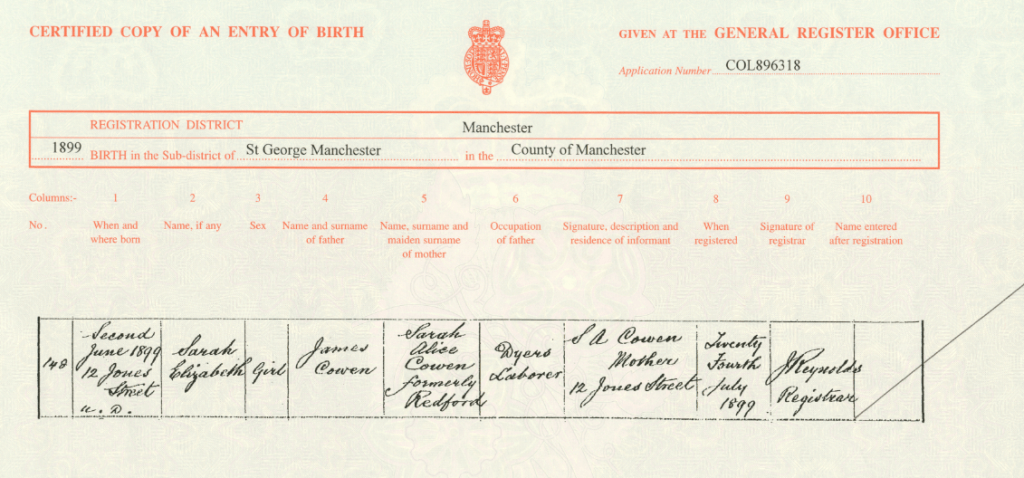
Their daughter Sarah Elizabeth was born on 2nd June 1899
In 1901 the family were living at 1 Peter Street and James was now working as ‘scavenger (corporation)’, which refers to James collecting refuse in the city and working for the local council.

1911 the family had moved to a 3 room dwelling, on Grey Street, off Hyde Road. James was still working for ‘corporation’ cleaning our streets.
Final Years
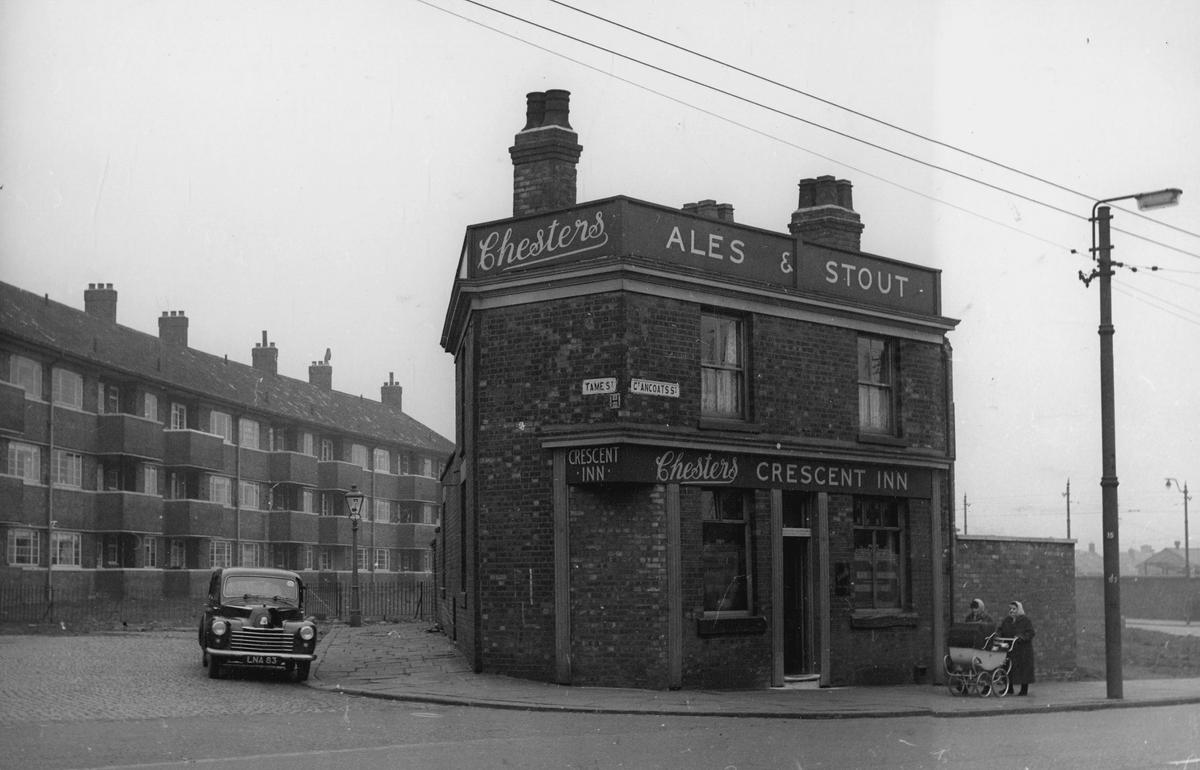
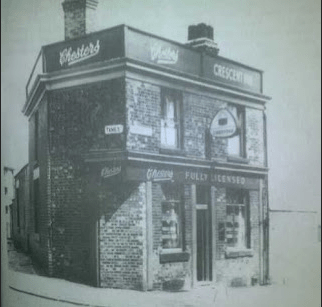
Sometime between the 1911 census and James’s death in 1914, the family left their rented accommodation and moved to The Crescent Inn on Great Ancoats Street. Living in a public house was not uncommon for working-class families at the time; it often provided more stable accommodation and sometimes work opportunities within the establishment. The Crescent Inn stood close to the neighbourhoods where James had spent much of his life.
James died on 20 July 1914. His cause of death was recorded as peripheral neuritis, a debilitating condition affecting the nerves. One possible contributing factor was his early work as a cotton dyer at the age of seventeen, where prolonged exposure to industrial chemicals—often without adequate protection—was common. Years of handling dyes, solvents, and heated chemical baths may well have taken a toll on his health.
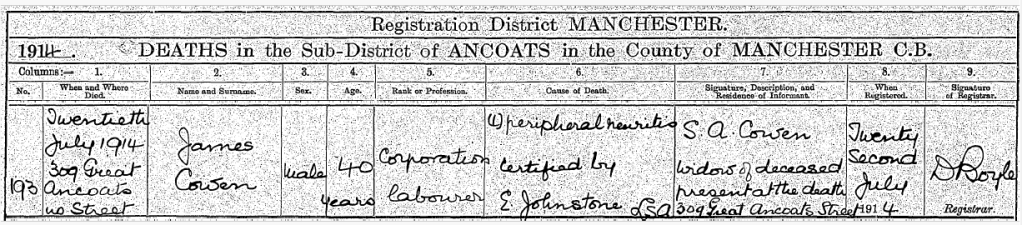

James was buried with his mother and brother in Southern Cemetery.
What happened next
Sarah Elizabeth, James’ daughter, was only 15 when her father died. She had idolised him and had likely witnessed him endure considerable suffering, making his loss deeply traumatic. Just three months after James’ death, her mother remarried on 5 November 1914. Family stories recall that Sarah Elizabeth struggled with this new marriage, finding it difficult to accept the change so soon after her father’s passing.
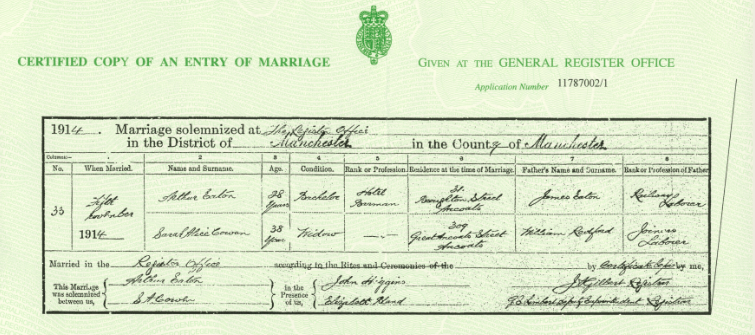
1921 census shows Sarah Alice and her second husband, Arthur Eaton, living in the Crescent Inn; both working for Chesters Brewery.
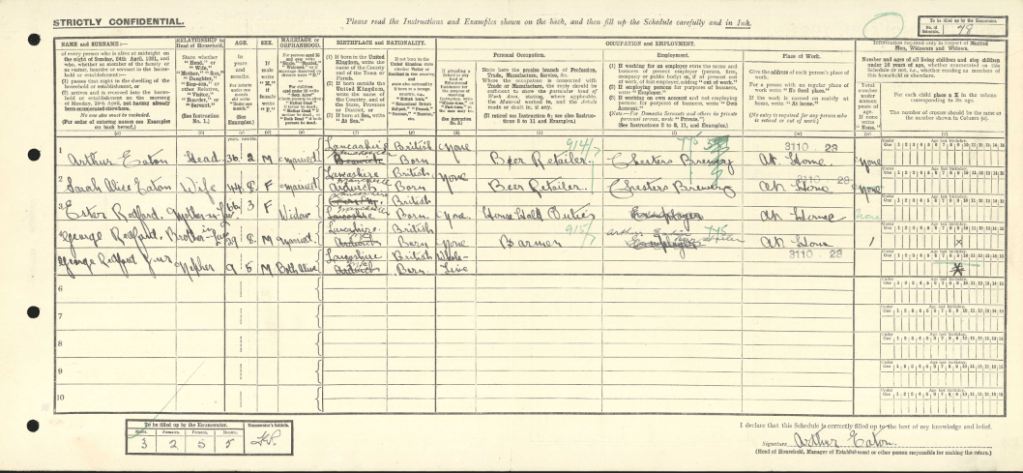
Arthur passed away in 1950, with his death certificate recording colon cancer as the cause. Six years later, in 1956, Sarah Alice died from a pulmonary embolism.
 Family