
We had a brief introduction to Harry earlier, but now it’s time to share his full story.
Early Years in Manchester
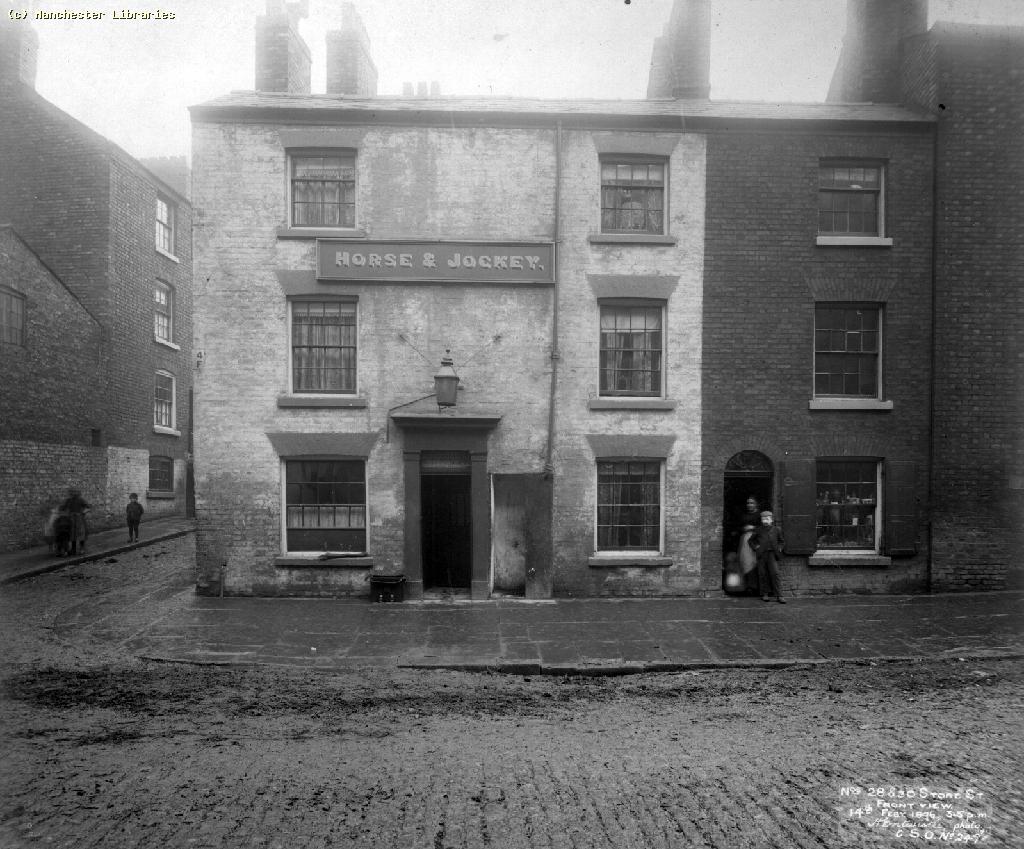
In 1896, the City Engineers Department undertook a survey of Manchester’s buildings and streets. These images, now available online (Manchester Image Archive), helped me identify the house where Grandad and his family lived—28 Store Street, Manchester.
For many years, I worked in Rail House on Store Street, and I was astounded to discover that my grandfather had lived just down the road—nearly 100 years earlier!
Their home was next door to the “Horse & Jockey” pub, and I was lucky to find a photo taken on 14 February 1896, between 3 pm and 5 pm. Seeing this image felt like stepping into history—especially knowing that my ancestors likely appear in it. At the time, Annie Moores (Great-Gran) and her son, possibly William Ernest (then 10 years old), may have been among the curious onlookers. A smaller child in the image might have been Margaret, who was just five.
A Growing Family
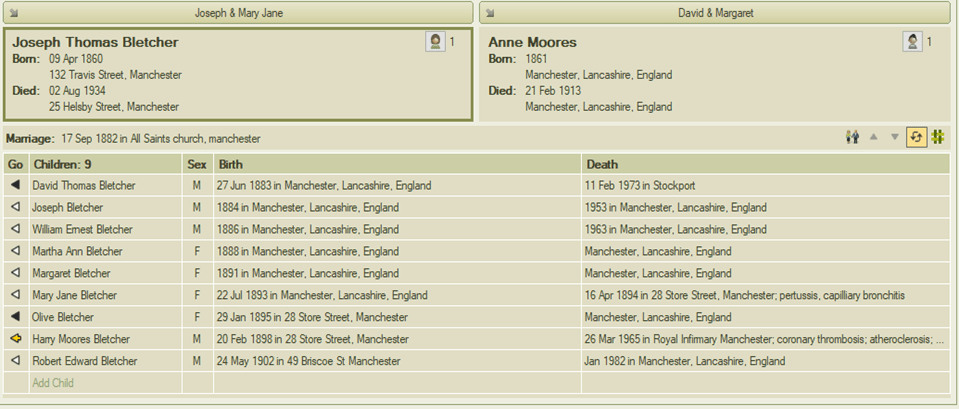
Harry Moores Bletcher was born on Sunday, 20 February 1898, the eighth child (and fourth son) of Joseph Thomas and Annie Moores. The couple had a total of nine children—five sons and four daughters.
Tragically, they lost one child, Mary Jane, who died at just 14 months old from whooping cough and bronchitis in 1894. While heartbreaking, they were considered fortunate, as child mortality rates at the time were staggeringly high—with one in five children not surviving past the age of five.
Baptism & Health Concerns
Harry’s baptism record raised questions—he was christened on 15 August 1898, a Monday, with “P.B.” noted in the margin. P.B. stands for “Private Baptism”, usually performed when an infant was gravely ill and not expected to survive.
Fortunately, Harry recovered and was officially received into the church on Sunday, 21 August 1898—just a few days later.

Life in Overcrowded Housing
The 1891 census reveals that 28 Store Street was a three-room dwelling, housing Joseph, Annie, and their children—up to 10 people in extremely close quarters!
By 1901, the family had moved to 19 Boardman Street, a four-room house that somehow accommodated 14 people. This included:
- Joseph Thomas, Annie, and their seven children
- Annie’s brother and his three children
- Joseph Thomas’ stepmother (noted as “mother-in-law” in the census, possibly due to confusion about how to record the relationship)
By 1910, the family relocated to 23 Limebank Street, off Ashton Old Road, and later, in 1911, to 7 Bridge Street, Ardwick—where they finally had five rooms for their growing household.
School Days & Early Work
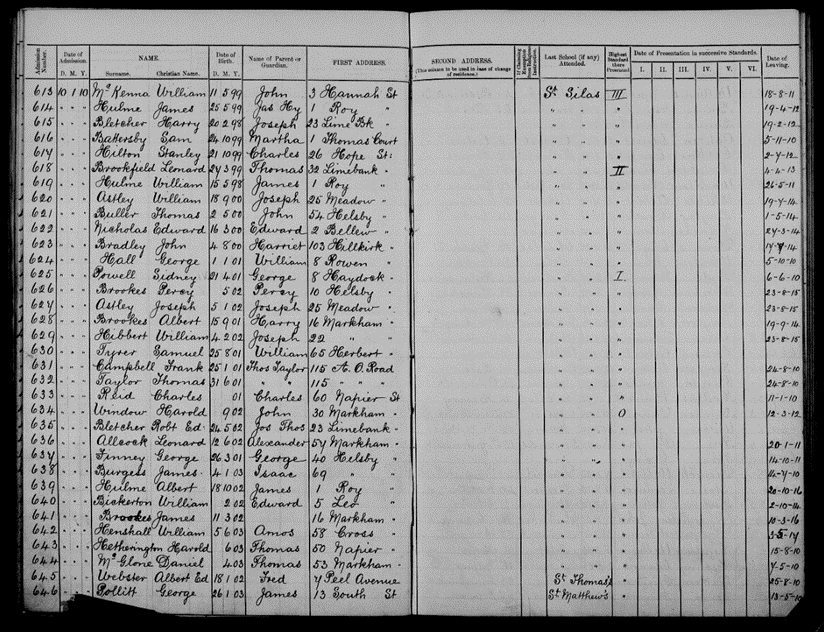
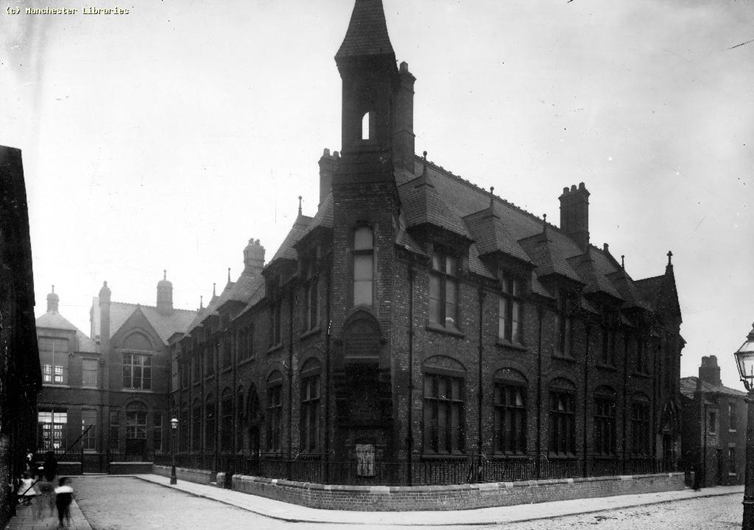
Harry and his younger brother Robert were registered at Chester Street School, Ardwick, on 10 January 1910. He remained a pupil until 19 February 1912, leaving school just shy of his 14th birthday.
At that time, compulsory education ended at age 12, though it was raised to 14 in 1918. Harry was among those fortunate enough to continue schooling past the minimum requirement.
Chester Street School, just off Ashton Old Road Ardwick.
A Determined Young Man – Military Service
On 7 April 1915, at just 17 years old, Harry Moores enlisted in the Territorial Force, claiming to be 19 years and 3 months old. His real age? 17 years and 1 month.
The Territorial Force (created in 1908) allowed men to train part-time while working civilian jobs, with the understanding that they could be called for full-time service during wartime. By 1914, however, Territorial soldiers were already serving full-time due to WWI—which may explain why Harry lied about his age to ensure he could enlist.
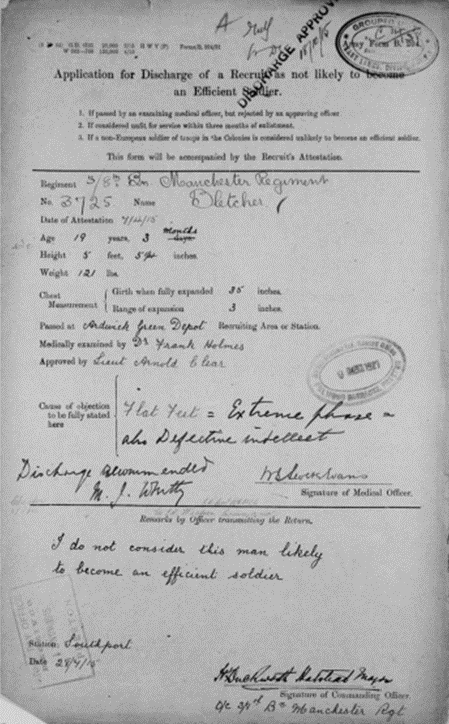
Unfortunately, his military career was short-lived. In July 1915, he was discharged with the comment:
“Not likely to become an efficient soldier”
The reason? Extremely flat feet and “defective intellect”—a vague and broad classification that could have meant anything from dyslexia to slow reaction times.
A Second Chance at Service
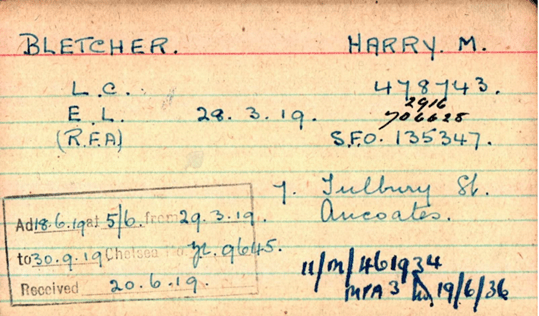
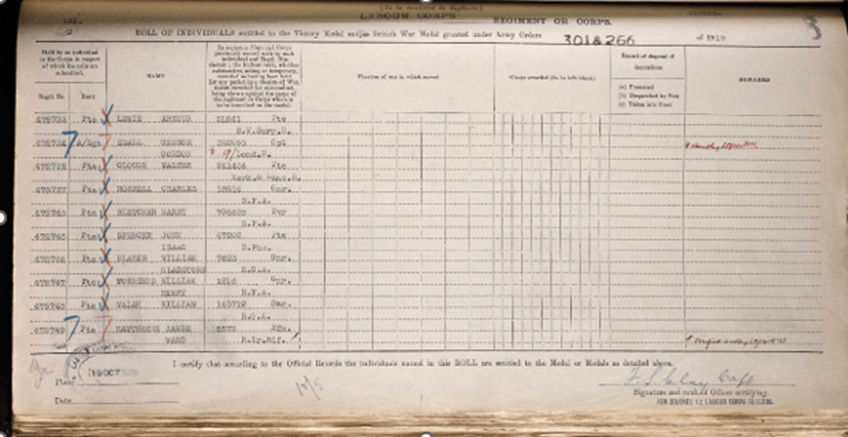
Despite his discharge, Harry was determined to serve. While I haven’t located all his records, I did find a medal card and pension card showing that he later joined the Labour Corps, East Lancashire Regiment, and Royal Field Artillery.
His two service numbers (478743 & 706628) suggest that he saw active duty in France from 1915.
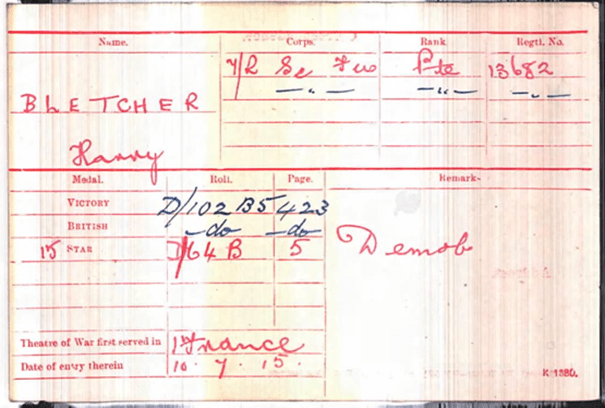
Medal card
Marriage & Family Life
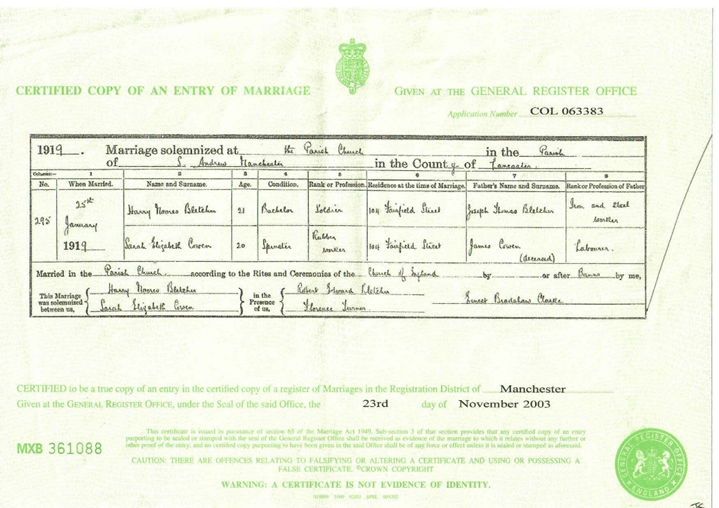
January 1919 was bitterly cold, with heavy snowfall in Northern England. On Saturday, 25 January 1919, Harry Moores Bletcher married Sarah Elizabeth Cowen at St. Andrew’s Parish Church, Travis Street, Ancoats.
Sarah’s mother ran a beer house on Great Ancoats Street, so it’s possible they met there. Interestingly, their marriage certificate lists both of their addresses as 104 Fairfield Street—likely an “address of convenience” to avoid paying for banns to be read in multiple parishes.
The 1921 census shows Harry, Sarah, and their first child, Harry Jr., living at 26 Gatley Street, Ancoats—a tiny three-room home they stayed in for several years.
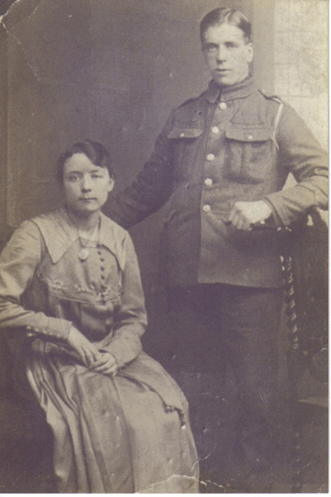
The earliest picture we have of Harry and Sarah could be their wedding picture. The uniform is very likely to be Harry’s Royal Field Artillery uniform.
The dates on the pension card (and the fact Harry stated he was a soldier on his wedding certificate in January 1919) would seem to suggest that Harry was demobbed at the end of March 1919.
The 1921 census shows Harry and Sarah living at 26 Gatley Street, Ancoats with their son Harry who was born in the early part of 1920. The house was compact, with 3 rooms in total for the small family and they lived here for some years.
Their daughter Olive followed in 1922 and then Margaret Ann in 1926. Sadly Margaret Ann died on June 1927, suffering from convulsions due to teething and exhaustion.
She is buried in the family plot in Southern Cemetery.
Ivy was born in 1928, Lilian in 1932 and finally Robert in 1935………..and their family was complete.

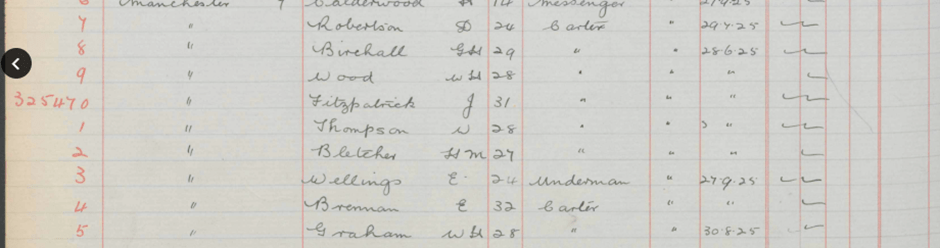
In 1925 and 1928 Harry is listed as a member of The National Union of Railwaymen, he was a Carter for the Midland Railway.
The 1939 register shows the family have moved to 2 Dantall Avenue, White Moss (near to Boggart Hole Clough and Booth Hall Childrens Hospital) – and here they stayed.
I remember Ivy (mum) telling us that Grandad had come home on leave, Gran had moved to Dantall Avenue whilst he was away; there were no buses or taxis – and it was a long walk, up a hill.

Final Years & Legacy
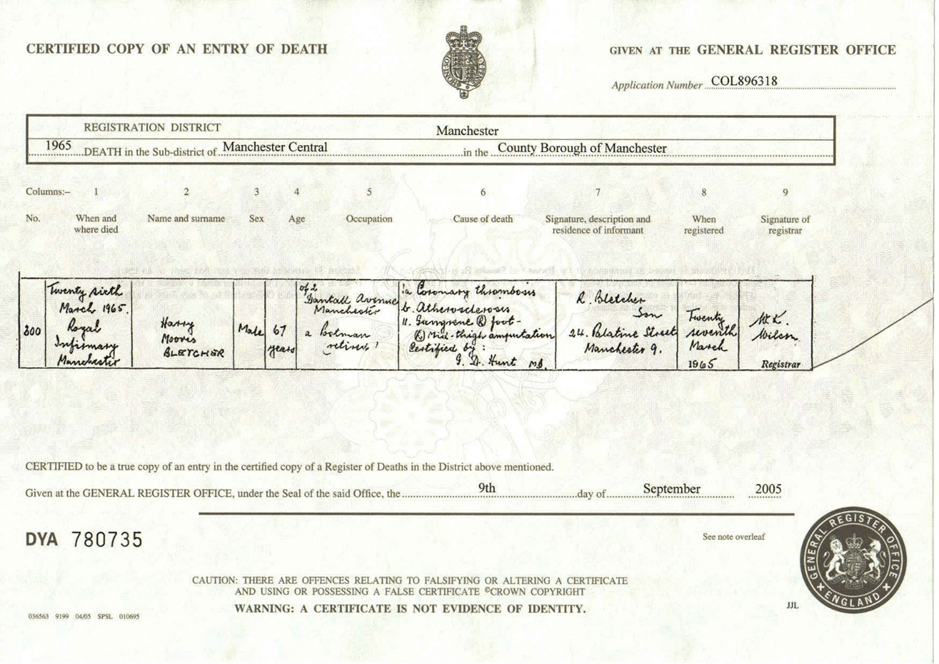
In March 1965, Harry underwent a lower-leg amputation due to an untreated infection that turned gangrenous. A week later, on Friday, 26 March 1965, he passed away at the age of 67.
His cause of death:
- Coronary thrombosis
- Atherosclerosis
- Gangrene (leading to amputation)
A Life Well-Lived
Harry faced many challenges—poverty, overcrowding, war, and health struggles—but his determination never wavered.
His legacy lives on through:
- 6 children
- 15 grandchildren
- An ever-growing number of great-grandchildren and great-great-grandchildren across the UK and Canada
 Family