
The early years
In October 1904, the weather was dull, rather cool and dry. It was Friday the 14th when Grandad Spencer was born – the fourth child of Bertha and Henry.
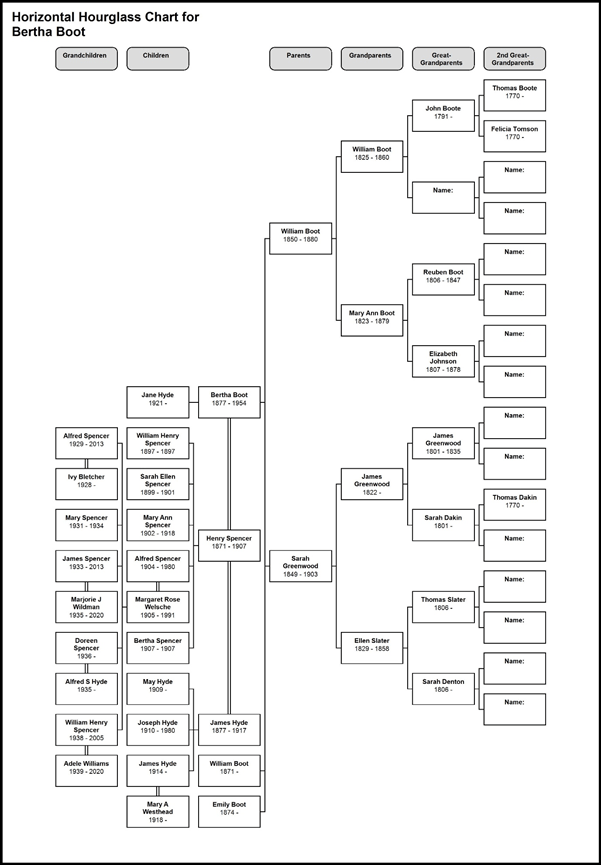
Bertha was my great-grandmother and this is her story.
Bertha was born on Sunday, 16 December 1877, to William and Sarah Ann. She was their fourth child, a younger sister to William and Emily. Their third child, Ada (born in October 1875), had sadly died just a few months earlier in July 1877, her cause of death recorded as measles and diarrhoea.
At the time of Bertha’s birth, the family lived at 12 Wilkinson St in the Oldham Road area, near Manchester city centre. In May 1878, Bertha was baptised at six months old, the family had moved to 148 Cheltenham St, Collyhurst – just around the corner from Willert Street Police Station
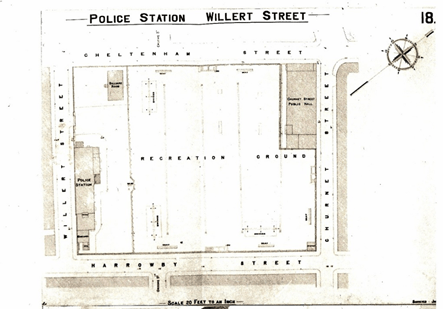
Every 10 years a census is conducted to count the population. In 1881, this took place on the evening of Sunday, 3 April. By this time the family had moved to 176 Cheltenham Street, and Bertha’s mother was now a widow. In January 1880, Bertha’s father, William, had died at just 29 years old.
William had worked as a shuttlemaker, crafting the wooden shuttles used in the cotton mills. It was demanding work with long hours. His cause of death was recorded as bronchitis, and it is likely that his job and the harsh working conditions contributed to his early death.
Left widowed with three young children, Sarah Ann had to support her family. She worked as a charwoman and took in a female lodger. Her daughters, seven year old Emily and three year old Bertha, remained with her, while her son William stayed with his aunt Emily, Sarah’s sister, at 6 Collyhurst Street.
In 1882, Sarah Ann remarried and had three more children from her second marriage – Arthur, born in 1883; Joseph, born in 1886; and Sarah Anne, born in 1888.
Bertha & Henry
On 26 December 1896, Bertha and Henry were married at St Mark’s Parish Church in Newton Heath. Henry, a 25 year old greengrocer, and Bertha, aged 19, chose a Boxing Day wedding – likely because Christmas and Boxing Day were traditional holidays long before becoming official bank holidays, ensuring time off for the occasion.
Just weeks later, on 14 February 1897, their first child, William Henry, was born.
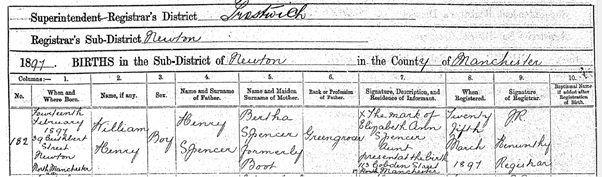
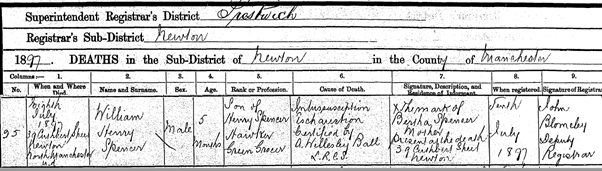
Tragically, less than six months later, baby William died. The loss of a child at such a young age must have been devastating. His death was caused by intussusception, a rare and painful condition in which part of the intestine folds into itself, blocking food and blood flow.
Their daughter, Sarah Ellen, was born on 18 September 1899, the family were living at 196 Cheltenham Street. Sarah Ellen was christened on 8 October in St James, Collyhurst; the register entry shows the family had moved to number 149 Cheltenham Street.


In the 1901 the census, taken on the evening of 31 March, Henry was recorded as an inmate in Workhouse & Workhouse Hospital, Crumpsall. When he later died in 1907, his cause of death was given as cardiac syncope and acute pthisis (tuberculosis and heart problems) – suggesting he had been a petient in the infirmary.
Bertha and Sarah Ellen have not been located in the 1901 census, it is possible they were not recorded or their names were not transcribed correctly.
More tragedy followed, on 11 July 1901, aged just 22 months, Sarah Ellen died from pneumonia. At the time, the family were living with Henry’s older sister, Hannah Jane, on Gunson Street in Newton Heath.
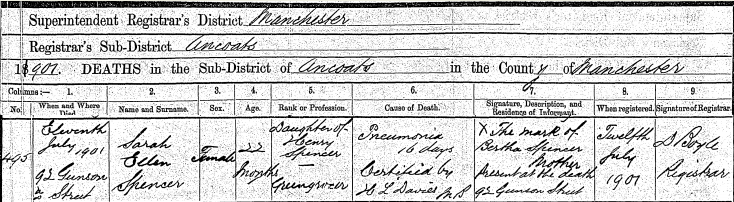
In the early 1900’s, infant mortality rates were alarmingly high due to the harsh and unsanitary living conditions. Families often lived in overcrowded homes with poor ventilation and limited access to clearn water, which facilitated the spread of infectious diseases like pneumonia, tuberculosis and diarrhea. Children were especially vulnerable to these illnesses.
Henry and Bertha’s third child, Mary Ann, was born on 21 February 1902, followed by Alfred on 14 October, 1904 and Bertha on 14 February 1907.
But more tragedy was to come. Henry died on 29 October 1907 from tuberculosis and cardiac syncope. Just six days later, on 3 November 1907, their nine-month-old daughter Bertha died from a cerebral haemorrhage and cardiac arrest. They are buried together in Phillips Park Cemetery, in grave D859.

This was an extraordinarily difficult period in Bertha’s life, highlighting the struggles families endured during that period and the resilience needed to persevere.
The later years
Life as a single mother would have been incredibly challenging. With limited support and strong social expectations, widows often remarried quickly. Bertha did just that – on 31 March 1908, she married James Hyde.
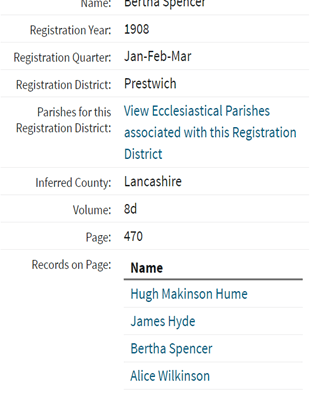
Bertha had two surviving children from her marriage to Henry, Mary Ann (b1902) and Alfred (b1904)
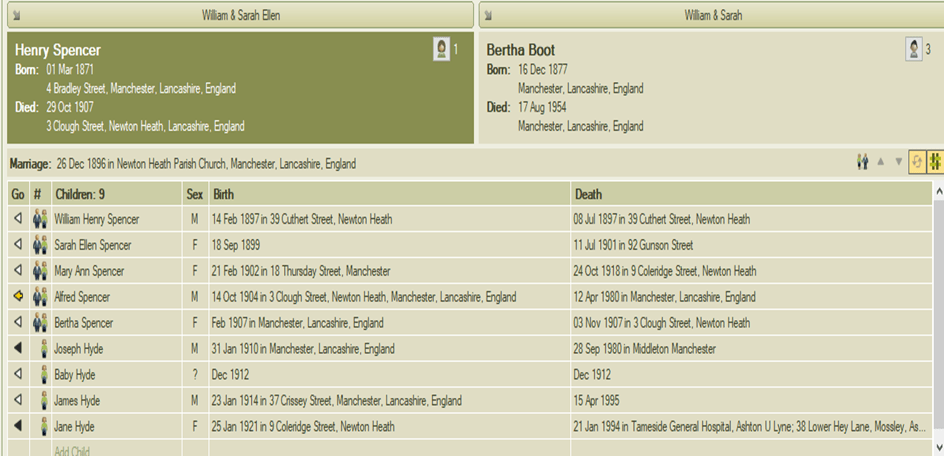
Bertha and James had three children together: Joseph (born 1910), James and in 1912 a still born baby recorded simply as ‘Baby Hyde’. The burial register lists the baby as stillborn (SB). All stillborn births were registered separately and no birth certificate would have been issued.

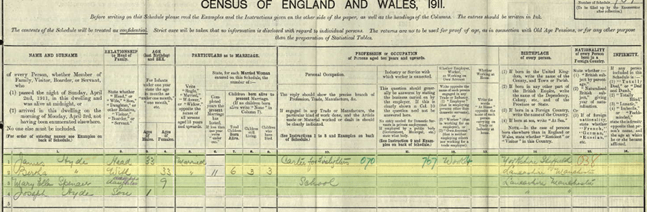
The 1911 census was taken on the night of 2 April and records James and Bertha, living at 37 Crissey Street, living with Mary Ann Spencer and Joseph Hyde b 1910.
At the outbreak of the First World War James joined the British Army and served in Flanders and northern France. Tragically, he was killed in action on 19 August 1917 and is buried at Bard Cottage Cemetery, a military cemetery in Ypres, Belgium. Bertha was widowed for a second time.
After the war
The 1921 census, taken on Sunday 19 June, gives us a fascinating glimpse into Bertha’s life at 9 Coleridge Street, Newton Heath where she was living with her sons Alfred Spencer, Joseph & James Hyde, daughter Jane Hyde and as well as her half brother Arthur Flynn and niece Susan.
9 Coleridge Street, Failsworth, was recorded in the 1921 census as having just three rooms – cramped conditions for two adults and five children to share.
A particularly poignant story emerges from this period. Arthur’s wife, Ethel, died in December 1917 at just 24 years old—only two days before their three-month-old daughter, Elsie. Bertha was present at Elsie’s death, a small but deeply human detail preserved in the records.
The 1921 census also presents a mystery. Jane Hyde, just five months old, is recorded as having a deceased father, yet James Hyde had died in 1917, making this impossible. Jane’s birth certificate leaves the father’s name blank.

Family stories tell that James Hyde’s brother Alfred was living with Bertha and was Jane’s father; Alfred is buried with Bertha, lending some weight to this account.
The later years
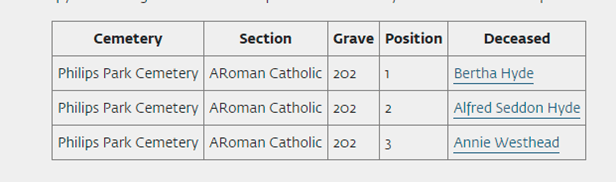
By 1939, Bertha was still living at 9 Coleridge Street with her youngest son, James. Next door at number 7 lived Annie Westhead, who became a close friend—so much so that they are buried together in Phillips Park Cemetery.
In 1940 James Hyde married the ‘girl next door’ Mary Westhead and on 23 June 1945 Jane Hyde married William Westhead, son of Annie Westhead. And the mystery of Jane’s father would seem to be solved; her wedding certificate shows Alfred Hyde as her father.

The wedding picture is Jane Hyde and William Westhead, Annie Westhead and her husband and Bertha and Alf Hyde.

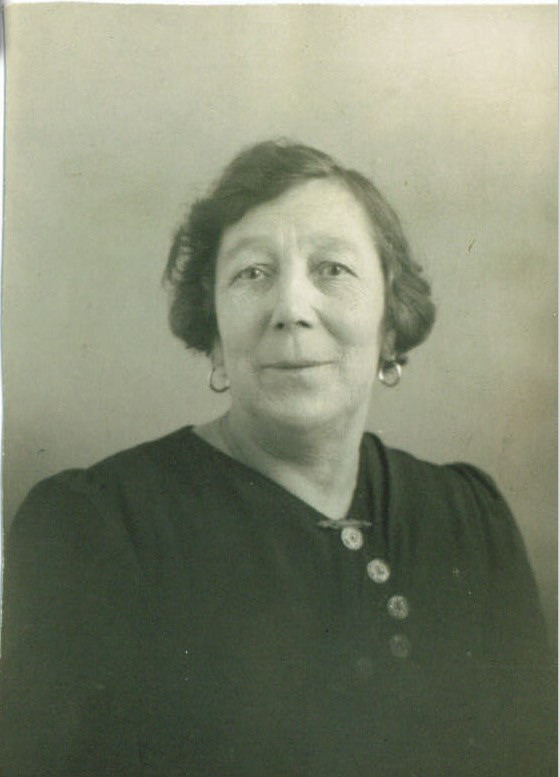
Bertha lived a long and eventful life. She gave birth to nine children, five of whom survived to adulthood. She endured the loss of two husbands and several children, yet continued to rebuild her life time and again.
She died on 17 August 1954 and was laid to rest in Phillips Park Cemetery, Manchester.

 Family