
During the late 19th and early 20th centuries, Failsworth and nearby Newton Heath were firmly industrial communities on the outskirts of Manchester. The area was dominated by textile manufacturing, bleaching, and dyeing works, which provided employment for much of the local population.
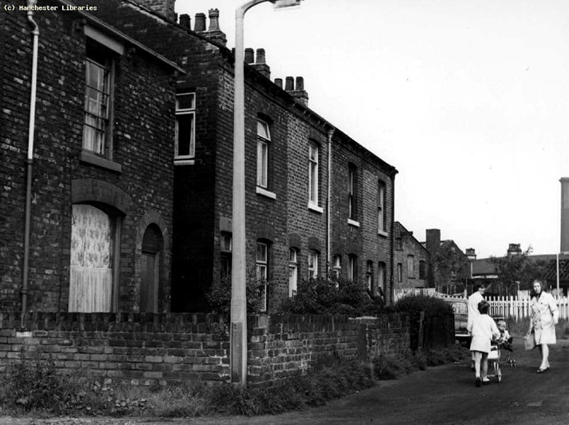
Housing for working families was typically in the form of small terraced properties, such as those on Mill Houses, Clough Street, and Coleridge Street. These homes were often overcrowded, with limited sanitation by modern standards. It was common for extended families or lodgers to share space, and frequent moves were typical as work and circumstances changed.
The Early Years
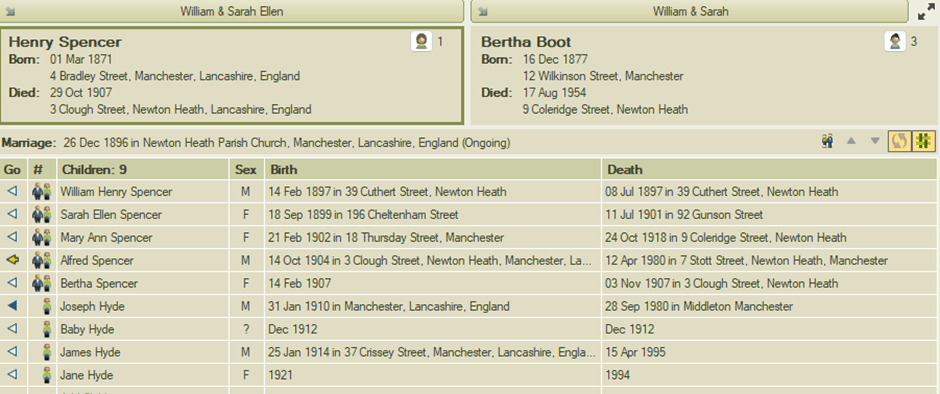
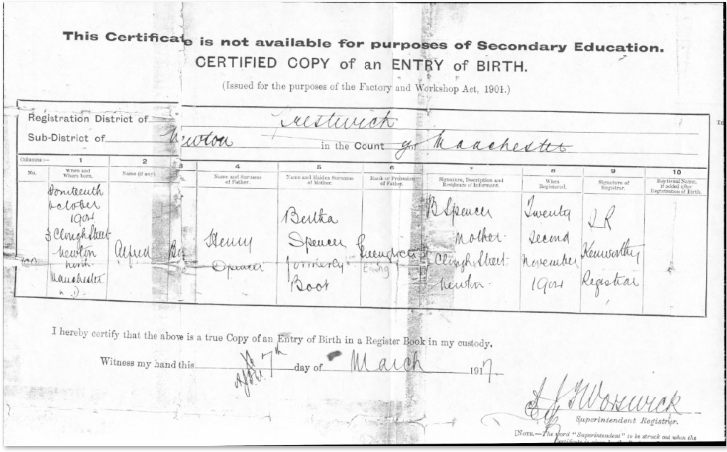
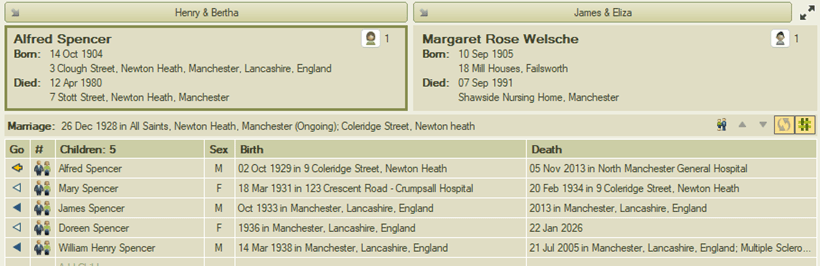
My grandad, Alfred Spencer, was born on Friday 14 October 1904, when the family lived at 3 Clough Street, Newton Heath. He was the fourth of five children born to Henry and Bertha Spencer (née Boot).
His early family life was marked by considerable tragedy. Three of his siblings—William, Sarah, and Bertha—died in childhood. Only Alfred and his sister Mary survived beyond infancy.
Further hardship followed in 1907 when Alfred’s father, Henry, died in the same week as his youngest daughter, Bertha. They were laid to rest together in the same grave. Although Mary survived into her teenage years, she too died young at the age of 16. As a result, Alfred became the only child from this marriage to reach adulthood.
In 1901, James Hyde lived at 1 Clough Street, suggesting that the families were already acquainted before Henry’s death. After Henry died on 29 October 1907, within 6 months Bertha had married James Hyde. At the time, such remarriages were common, offering stability for widowed mothers with young children.
Bertha and James went on to have three children:
- Joseph (1910)
- James (1914)
- A child registered as “Baby Hyde,” who was born and died in December 1912
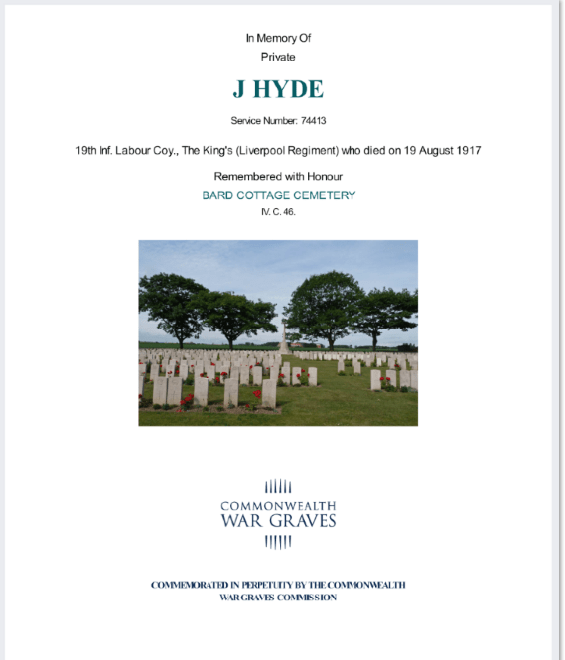
James Hyde later served in the First World War and was killed in action on 19 August 1917. He served with the 19th Infantry Labour Company attached to The King’s (Liverpool Regiment) and is buried in Bard Cottage Cemetery near Ypres, Belgium.
1921 Census
The 1921 census records Alfred—listed as “Alf Hyde”—living at 9 Coleridge Street with:
- His mother, Bertha
- Half-brothers Jim and Joe
- Half-sister Jane
- His uncle Arthur and cousin Susan
At age 16, Alf was working for the Great Central Railway as a greaser.
1924: Army Enlistment
In 1924, Alfred enlisted in The Lancashire Fusiliers for a 12-year term. His records incorrectly list his birth year as 1905 instead of 1904, although his age is correctly recorded as 18.
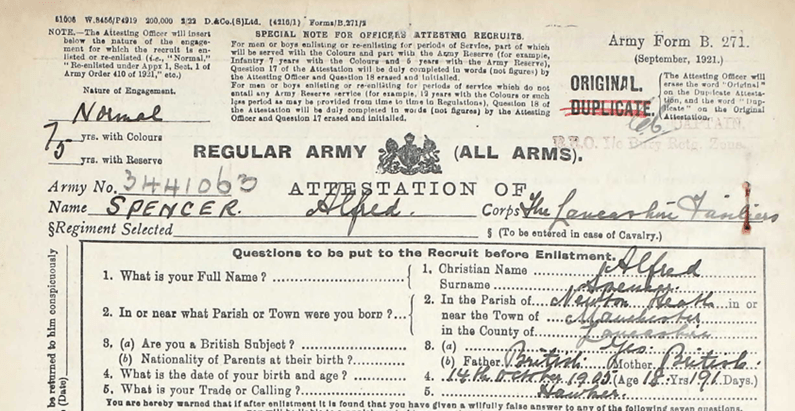
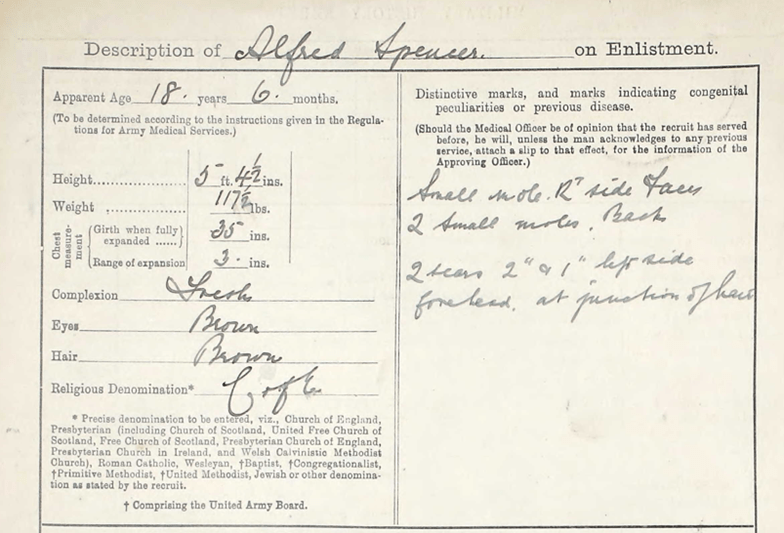
Army life appears to have been challenging for him. Records from July and November 1924 note instances of:
- Pay forfeiture
- Detention for absence
On 17 January 1925, Alfred was discharged following a conviction by civil authorities for larceny.
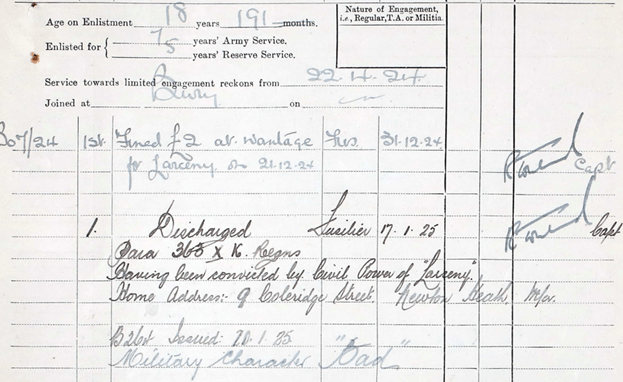
Despite this, he later re-enlisted at the start of the Second World War, indicating that this early discharge did not permanently affect his service.
Family Life
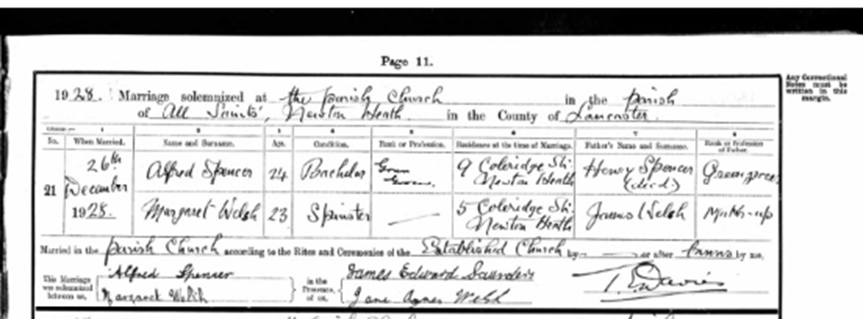
On 26 December 1928, Alfred married Margaret Welsche at All Saints Church, Newton Heath. At the time, both were living on Coleridge Street, where they continued to live for many years.
The couple had five children. Tragically, their daughter Mary died at the age of 2 years and 11 months. Her cause of death was recorded as:
- Bronchopneumonia
- Measles
- Cancrum oris (a severe gangrenous condition affecting the mouth and face)
Bronchopneumonia was the final complication.
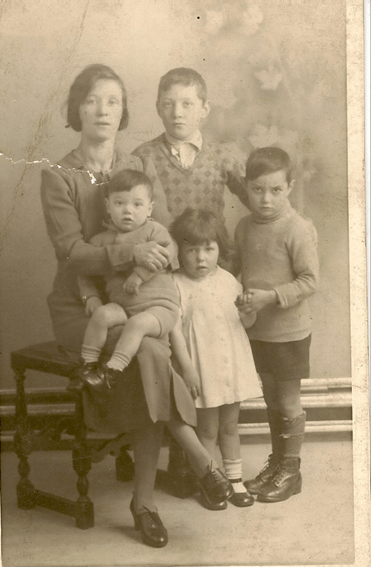
A photograph from around mid-1939 shows Margaret surrounded by her children:
- Alfred (b. 1929)
- Jim (b. 1933)
- Doreen (b. 1936)
- William (b. 1938)
Extended Family Connections
Family ties remained close:
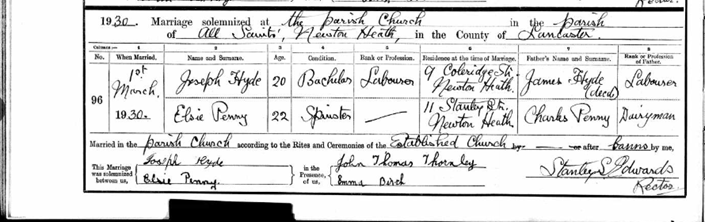
Alfred’s half brother Joe Hyde married Elsie Panny on 1 March1930, in All Saints Church, Newton Heath
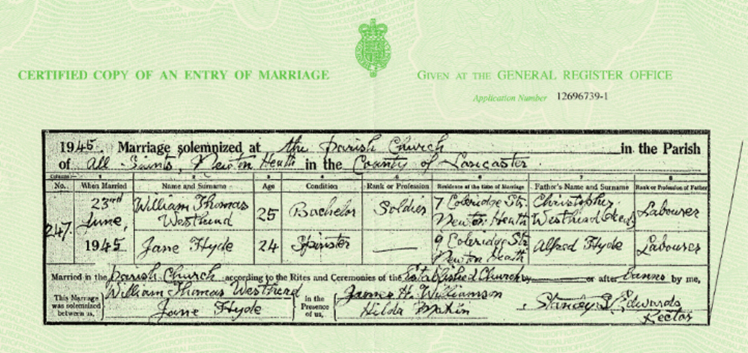
James Hyde married ‘the girl next door’ Mary Westhead in 1940, the couple having grown up living just a few doors apart on Coleridge Street.
The 1939 Register
The 1939 Register provides a detailed snapshot of family life. Alfred, Margaret, and their four children were living at 27 Coleridge Street.
Nearby relatives included:
- Margaret’s mother at number 5
- Alfred’s mother Bertha Hyde at number 9
- Annie Westhead (a very close family friend) at number 7
- The Birch family (related through Hyde family) at number 13
- Joseph Hyde at number 31
With so many relatives living within a few doors, life on Coleridge Street was defined by strong community and close family ties.

Second World War Service
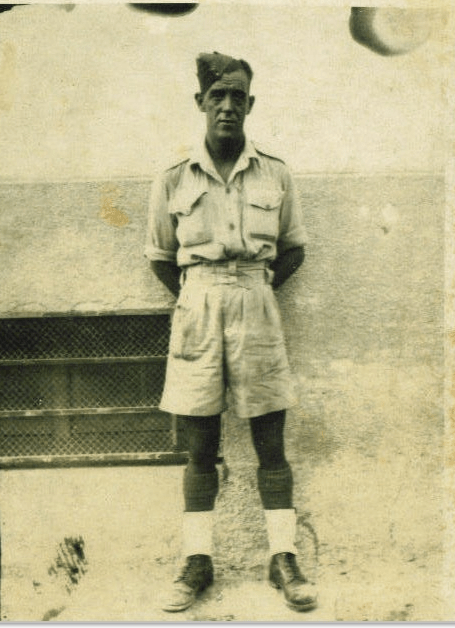
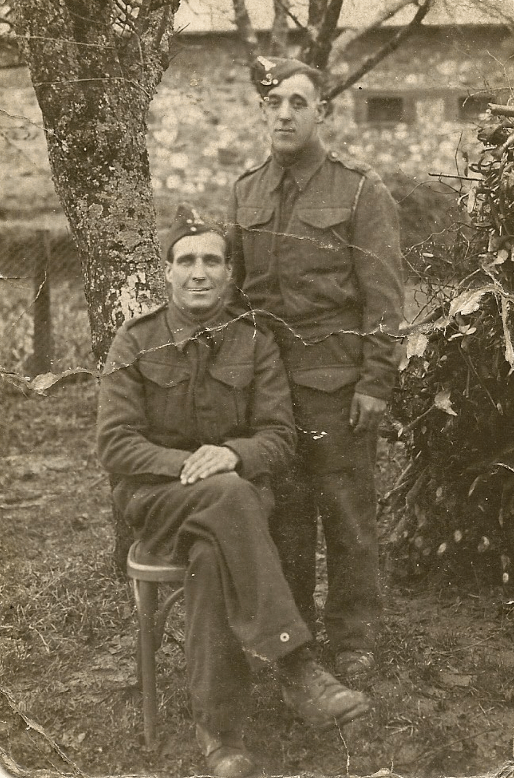
Alfred remained close to his half-brothers Jim and Joe. At the outbreak of the Second World War, all three enlisted.
Alf rejoined the 1st Battalion, The Lancashire Fusiliers, later serving with:
- The Manchester Regiment
- The Pioneer Corps
There is, however, a small inconsistency in his records – Alf appears to have recorded his marriage as taking place in 1927, whereas official records confirm that he married Margaret on 26 December 1928, a reminder that even formal documents can occasionally contain such minor inaccuracies.
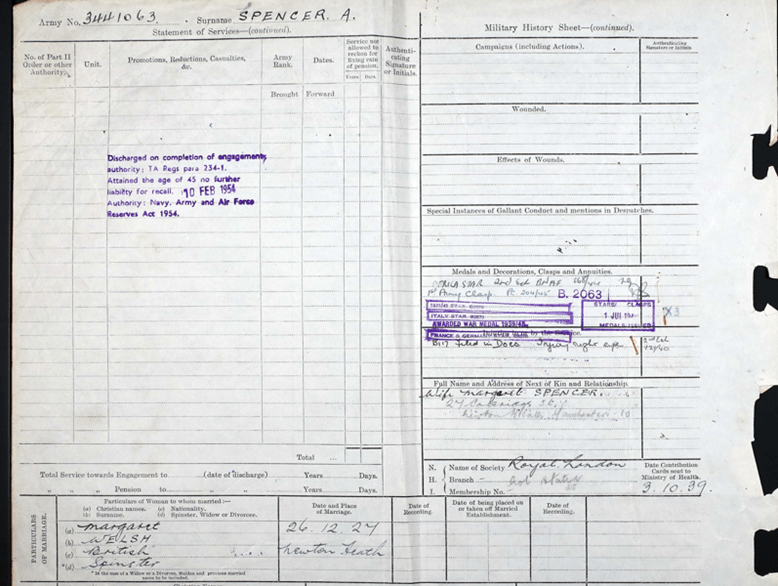
Both Alf and Joe were part of the British Expeditionary Force that landed in France in the very first days of the war.
Family stories tell that during the retreat to Dunkirk; each independently visited the grave of their father/stepfather James Hyde. Remarkably, while waiting on the beach for their evacuation, managed to find each other amidst a German air raid.
There is a story that Alf’s picture featured in the Manchester Evening News about this time, after he had managed to damage and destroy a German aircraft with a machine gun.
Service records for Joe and Jim Hyde have proved difficult to trace; however, family accounts suggest that Joe was taken prisoner of war and held in a Japanese POW camp during the conflict.
Service Timeline
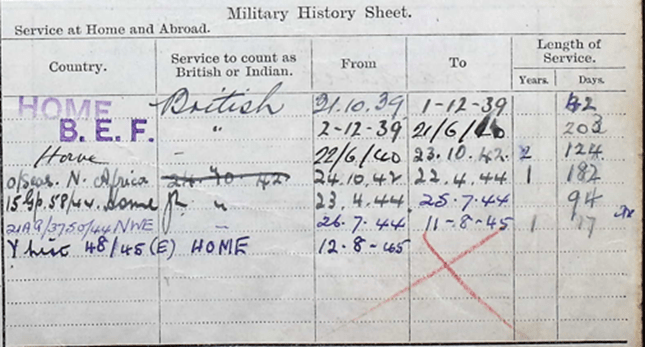
Alf served for 6 years during WW2:
- 1924-26: Lancashire Fusiliers (early service)
- WWII:
- Manchester Regiment (enlistment)
- Pioneer Corps (main service)
- Served in:
- 1939 – 1940 France (BEF)
- Arrived Nov 1939
- Likely evacuated via:
- Dunkirk evacuation
- 1941 – 1944 North Africa
- With 132 Corp and others (Pioneer Corps)
- Present through:
- Operation Crusader
- First Battle of El Alamein
- Second Battle of El Alamein
- Tunisia Campaign
- Late 1944 North West Europe
- Places him in the aftermath of Normandy landings
- 1939 – 1940 France (BEF)
- Discharged:
- 15 November 1945
Role as a Pioneer
His duties would have included:
- Clearing debris and battle damage
- Repairing roads and supply routes
- Supporting logistics behind advancing forces
Especially critical during:
- Rapid Allied advance after Normandy
Campaign Medals
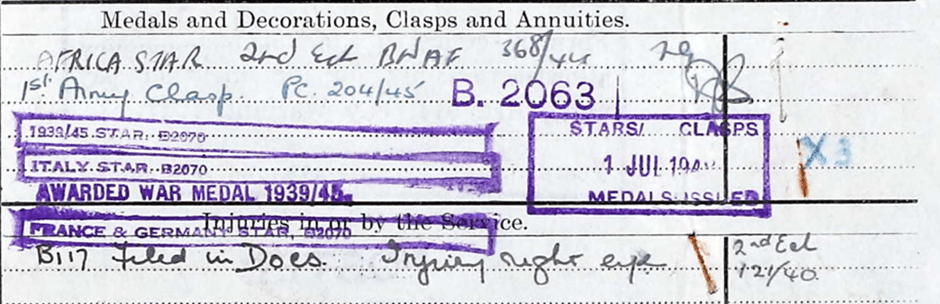
Alf was awarded several campaign medals:
- Africa Star
- Awarded for service in North Africa
- Covers campaigns like:
- Western Desert (against Rommel)
- Tunisia campaign
- Usually earned between 1940 – 1943
- Italy Star
- Awarded for service in the Italian Campaign
- Includes:
- Sicily
- Mainland Italy (1943-1945
- 1939-1945 Star
- Given for overall operational service during !!2
- One of the standard campaign medals
- Required a minimum period of active service
- War Medal 1939 – 1945
- Awarded to all full time personnel who served at least 28 days
- Essentially a general service medal for the war
- France & Germany Star
- Awarded for service in North West Europe
- Covers:
- D-Day (June 1944 onwards)
- France, Belgium, Netherlands, Germany
After the War
After the war, Alf and Margaret remained in Newton Heath. In the 1960s, they moved to Stotts Lane, later settling at 7 Stott Street.
Alf spent much of his time at his allotment—“the pen”—and was rarely seen without his dog, Teddy, a large grey wire-haired greyhound-type.
Family remained close:
- Doreen lived nearby
- William lived on Farm Street – 5 minute walk
- Jim later moved within walking distance
A long-standing family tradition saw everyone gather each year on 26 December to celebrate Alf and Margaret’s wedding anniversary.
Working Life
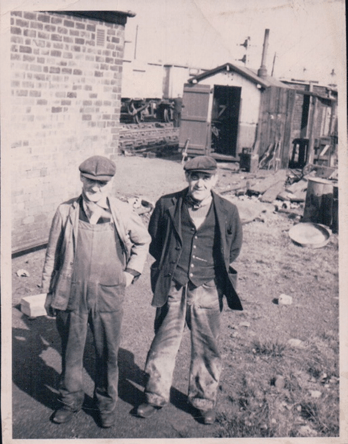
Alf worked on the railway, likely at Newton Heath Depot. His death certificate records his occupation as retired railwayman.
Final Years
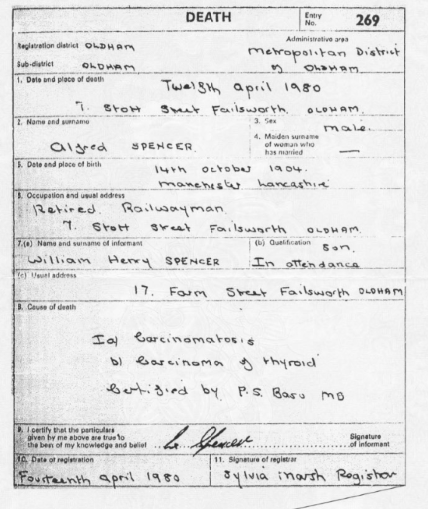
Alf died on 12 April 1980, at the aged of 75; the cause of death was recorded as carcinomatosis, resulting from a carcinoma of the thyroid. This indicates that the cancer originated in the thyroid gland but had spread throughout the body by the time of death.
At the time, treatment options for such conditions were limited, particularly once the disease had reached this advanced stage.
Reflection
Alfred Spencer lived a life shaped by both hardship and strong family ties. The only child of Bertha and Henry Spencer to reach adulthood, his early years were marked by loss, yet he remained closely connected to his extended family throughout his life.
He spent his working years as a railway man in Newton Heath, rarely straying far from the community in which he was born. A husband to Margaret and father of five, Alf’s life was firmly rooted in family. Despite an eventful early adulthood, including military service in both peacetime and war, his later years were defined by close family connections and the simple routines of home, work and working on ‘the pen’.
 Family